Who decides, and who's at the table
A score is only as good as the room that produced it. Name who decides at each level of stakes, bring the right perspectives to each dimension, check equity and accessibility explicitly, and agree up front on how disagreements get resolved.
Decision rights by band
Authority scales with stakes. Low-risk uses are decided close to the work; high-stakes uses go to bodies with broader accountability. Decision rights are one part of proportionality: the whole process scales with the band.
| Band | Who scores | Who decides | Typical conditions |
|---|---|---|---|
| Low | Proposer, unit lead, local IT contact | Unit or department lead | Follow published guidance; register the use. |
| Moderate | Cross-functional review team | AI governance lead or committee delegate | Documented mitigations; review at the end of the pilot. |
| High | Full team plus specialist reviewers | AI governance council | Required safeguards, a monitoring plan, and efficacy evidence before scaling. |
| Critical | Council, specialists, and representatives of affected groups | Executive sponsors, on council recommendation | Alternatives considered first; extensive controls; time-limited approval. |
Escalation rule. A 5 on ethics & compliance or stakeholder impact moves the decision up one level, whatever the total. A low total should never hide a single severe risk.
Role names are illustrative. Map them to your institution's governance structure.
Who's at the table
Every dimension needs the people who can see its risks. Use this as a checklist when convening a review team.
| Dimension | Bring in | Why |
|---|---|---|
| Strategic fit | Institutional planning, deans or unit leaders, the proposer | Confirms the link to defined strategic goals. |
| Ethics & compliance | Privacy, information security, legal or general counsel, accessibility, research compliance (IRB) where relevant | Catches FERPA, ADA, data, bias, and contract issues before commitment. |
| Financial viability | Budget office, procurement, the service owner | Tests total cost, ongoing funding, and vendor terms. |
| Operations & innovation | Central IT, enterprise architecture, the staff whose workflow changes | Checks integration, support load, and scalability. |
| Stakeholder impact | Students, faculty, and staff from affected groups; shared governance; communications | The people affected see harms and trust issues others miss. |
Nothing about them without them. When an initiative scores 4 or higher on stakeholder impact, include people from the affected population in scoring, not only in later consultation.
Your governance structure shapes the Compass
The Compass isn't used the same way everywhere. How an institution organizes AI governance decides who scores, who decides, how formal each review is, and how much effort a proposal takes. Set those choices to fit your structure before you adopt the rubric.
| Centralized | Federated | Distributed | |
|---|---|---|---|
| Typical setup | One AI council or office reviews everything | A central council sets standards; colleges and divisions review their own | Units govern AI locally with light central guidance |
| Criteria | One rubric, applied the same way everywhere | Shared core rubric; units may add descriptors for their context | Units adapt the rubric; central office sets minimum questions |
| Who decides | Mostly the central council, even for low bands | Units decide Low and Moderate; council takes High and Critical | Units decide most bands; escalation is the main central check |
| Formality | Consistent, often heavier for small ideas | Scales with the band, as on this site | Varies by unit; hardest to compare |
| Effort and speed | Queues build at the center | Balanced; depends on clear hand-offs | Fast locally; duplication across units |
| Watch for | Bottlenecks that push people around review | Units scoring the same risk differently | Gaps in high-risk review and no portfolio view |
The defaults on this site assume a federated model. Most institutions are a mix: name yours, then adjust the decision rights, review formats, and timeframes to match.
How the roles work together
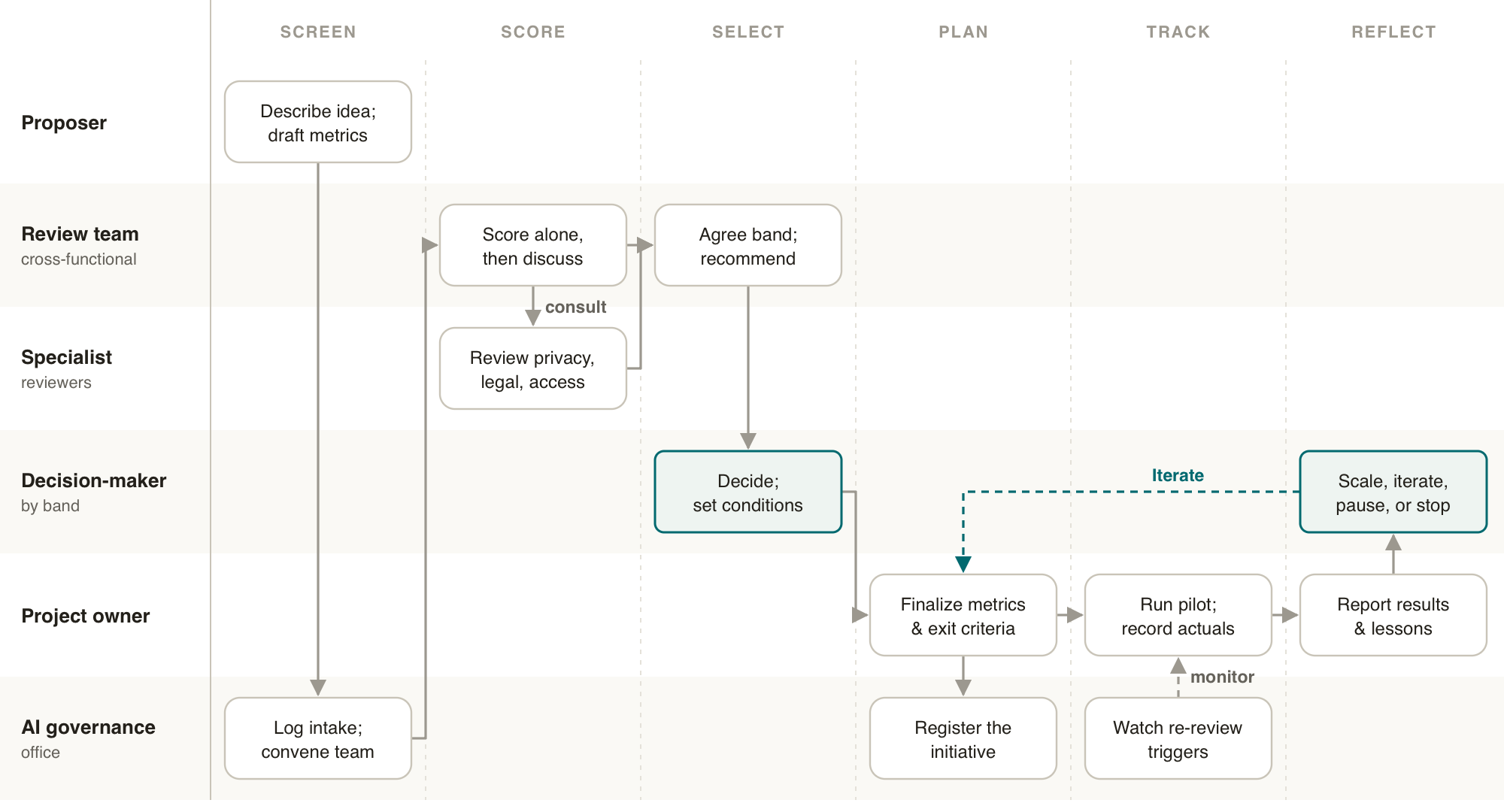
Each step of the Compass belongs to someone. This cross-functional view shows who does what, and where work hands off between roles.
Equity & accessibility check
Equity and accessibility run across all five dimensions, so they get an explicit check rather than being left implicit inside ethics. Answer these before the team settles on scores:
- Who benefits, who bears the risk?Are benefits and burdens distributed fairly across student, faculty, and staff groups?
- Does it work equally well for everyone?Is there evidence the AI performs consistently across demographic groups, languages, and disability status?
- Is it accessible?Does it meet accessibility standards (e.g., WCAG, ADA), with accommodations for people who can't use it?
- Can people opt out?Is there a non-AI path that doesn't disadvantage those who decline?
- Does it close or widen gaps?Could it reinforce existing inequities in access, outcomes, or digital literacy?
- Who was consulted?Were affected groups part of the design and review, or only informed afterwards?
Record answers in the ethics and stakeholder-impact comments, and track fairness through an efficacy measure, for example accuracy within a set margin across groups.
Disagreement & appeals
Disagreement is useful information. A clear process keeps it from turning into a stalemate or an override.
- Score independently first. Each reviewer scores alone before discussion, so the loudest voice doesn't anchor the room.
- Discuss the spreads. Any dimension where scores differ by 2 or more points gets discussed before the team agrees a score.
- Record dissent. If the team can't converge, note the minority view and its reasoning in the comments. It travels with the decision.
- The decision-maker rules. The authority for the band decides, with the scores, comments, and any dissent in front of them.
- Reconsideration and appeal. A proposer may request reconsideration with new evidence, or appeal one level up. Each initiative gets one appeal per decision.
Representative roles and timeframes. The deciders, review formats, and target times on this page are examples, not actual institutional policy. Set your own to fit your governance structure.