From idea to action
Six steps take an initiative from a first idea to a decision about its future: screen, score, select, plan, track, reflect.
Define success up front. Finalize it after evaluation. During intake, proposers draft intended KPIs, OKRs, and efficacy measures as a starting point. This drives clarity and focus without requiring perfection. Formal success planning happens only after rubric evaluation and selection.
- ScreenDescribe it; draft KPIs, OKRs & efficacy
- ScoreRate five dimensions as a team
- SelectProceed, pause, or revise
- PlanFinalize targets & timeframes
- TrackRecord actuals in the pilot
- ReflectCapture lessons; decide
- Screen: the proposer describes the initiative and drafts intended outcomes, outputs, and efficacy measures.
- Score: a cross-functional team rates the five dimensions and records its reasoning.
- Select: the total and review band inform the decision to proceed, pause, or revise.
- Plan: selected initiatives finalize OKRs, KPIs, and efficacy measures with targets and timeframes.
- Track: owners record actuals against targets through the pilot, including how accurately and fairly the AI performs.
- Reflect: the team captures lessons and decides to scale, iterate, pause, or stop.
The full workflow
The six steps with every decision point and loop shown: where an initiative escalates, where it can revise or stop, and how a live tool comes back for re-review. Every initiative follows the same path, but how formal each step is scales with its band. For who does each step, see the cross-functional view.

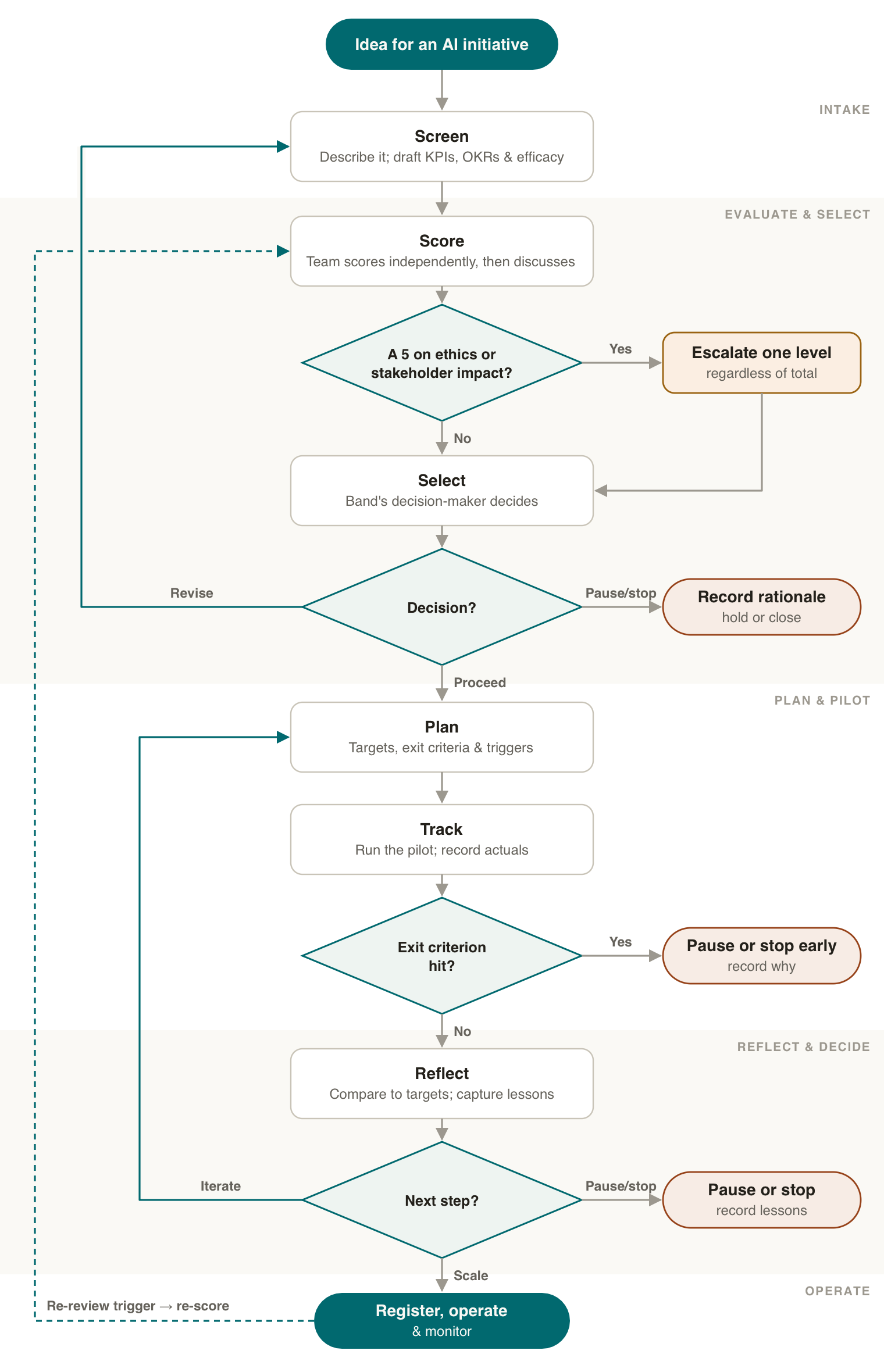
A representative process. The steps, decision points, and loops show one way to run the Compass. Your institution may combine, add, or reorder steps to fit its own governance.